This post looks at 12 ARC records released on 30 January 2026 which have not previously appeared online. Are these truly new documents? If yes, where did they come from and what is in them? If they were previously available on-site at NARA, why have they only been posted online now? Do these pdfs have information in them previously unavailable? Read on to find out more!
“New” HSCA typewriter ribbons
In 2022, NARA published its “Transparency Plan” (TP). This covered the release of all ARC material NARA was responsible for reviewing. The TP (and a cover letter) were sent to the NSC. They are available here.
As the TP notes, “Two hi-yield typewriter ribbon cartridges [from HSCA] require a review for classified equities and NARA lacks the capability to evaluate the information in its current format. … Information will be released when a process is developed to safely unspool the cartridges and transfer the information to a digital format. NARA is currently developing a procedure.”
The procedure was duly developed, and the result is in two 2026 pdfs: 180-10142-10055 and 180-10142-10194.
Following are two “pages” from these pdfs:
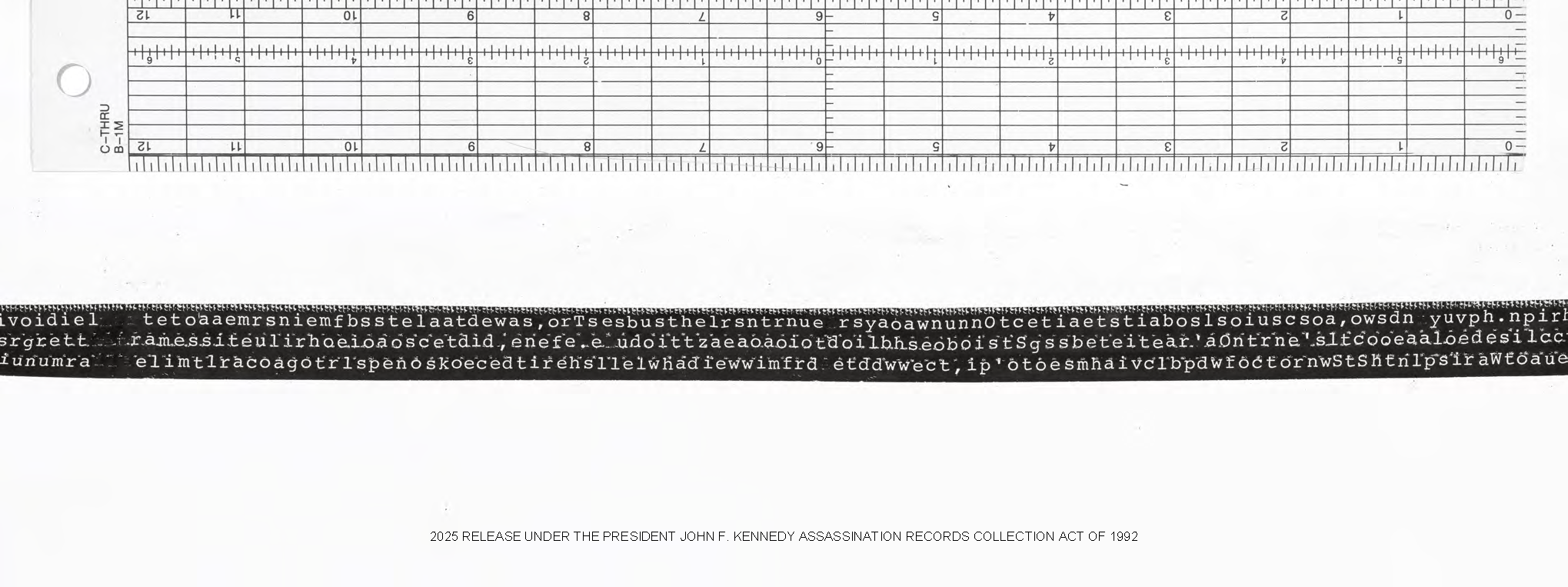
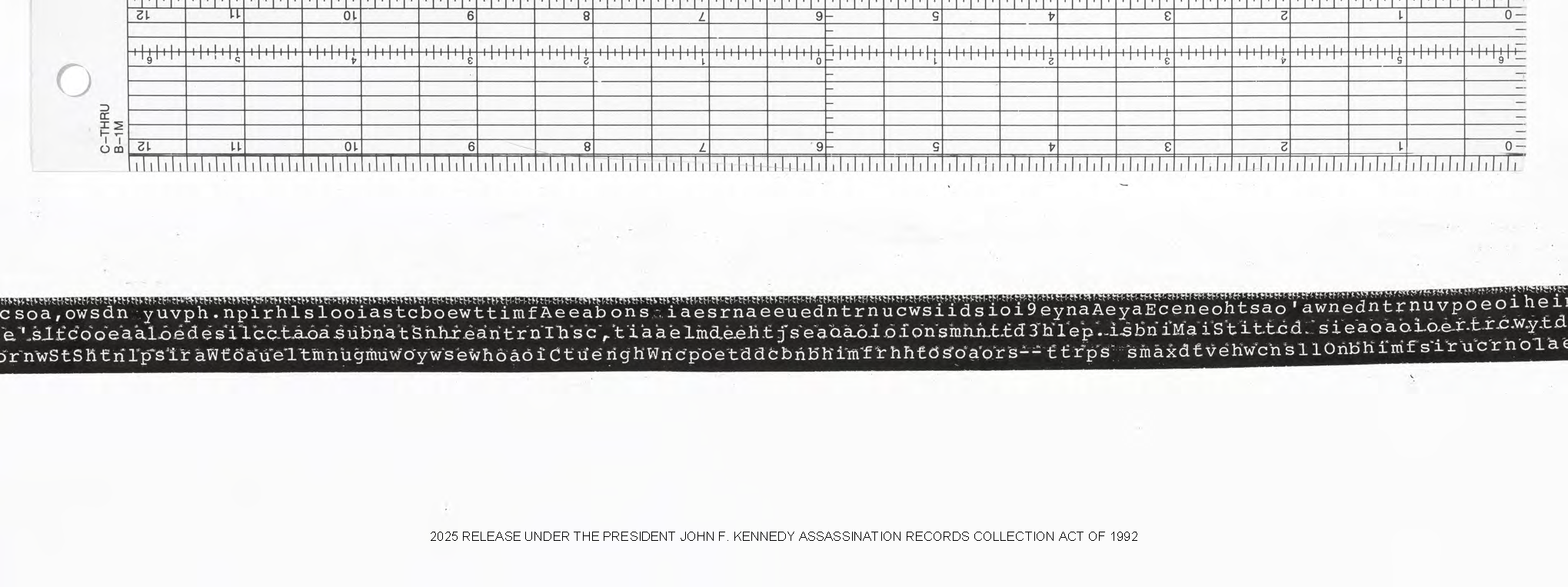
There are a total of over 1100 pages of this gibberish in the two ribbon pdfs. Why are the ribbons like this? No idea. Maybe these were just used for corrections? A more relevant question, perhaps, is why the ribbons were kept in the first place, rather than being destroyed as office waste, like most ribbons were? And why did the ARRB decide to put them in the collection? Did they suspect some hidden information or clues were on them? Or was it just the pack rat in the ARRB? Again, who knows?
Anyway, mark up two records that were never previously available in any format.
“Overlooked” Eisenhower Library records
The January 2026 docs also included two records from the Eisenhower Library. These records were not previously available online. In fact, they are not even listed in the JFK database. As I have previously discussed in several notes, such as this one, the Eisenhower Library is not the only agency to have this problem.
Writing to NARA about this problem got the following explanation: these gaps in the JFK database are due to problems with the data disks that the agencies filled out in 1993-1998. Some of the disks were damaged or otherwise unusable and could not be merged into the main database.
Before this happened, however, the agencies printed out the required RIF sheet for each document and either attached it to the docs, or sent copies to NARA. So the data is there, it just needs to entered into the database.
Rather than devote its resources to this task, however, NARA decided to deal with it after the records were all posted online. This massive project is well underway, but who knows how long before it is complete. In the meantime, NARA says, the records, and the RIF sheets, are available on-site at NARA for those who want to make the trip.
These gaps have had an effect on NARA’s release of redactions, causing them to overlook documents that were released with redactions in 1993-1998, after NARA attempted to get these opened up in the 2017-2025 releases
In releasing records for 2025 and 2026, NARA has finally turned up some of these overlooked documents and is now posting them online.
This is what happened with two Eisenhower Library records released in 2026, 203-10001-10000 and 203-10001-10012.
The JFK database lists no records from the Library, nor have any ever been posted online, either in 1992-1998, or in 2017-2025. This is frustrating when trying to keep track of how many Eisenhower Library records there are, and whether any more records need releasing.
However, it turns out we can answer this question by looking back at the notices the ARRB was required to publish in the Federal Register from 1994-1998.
The JFK Act required ARRB to keep the public informed of its progress on releasing JFK records by publishing running counts of what was released in full and what was released with redactions in the Federal Register. These notices also state when the redactions were to be released.
Going back to look at these, we find that 16 RIF numbers for Eisenhower Library records were published in the Federal Register in March and April 1998. Of these, 14 were released in full. Two were were released with redactions that were to be opened in 2017. These are the same two that NARA posted on January 30.
So, not much stuff from Eisenhower Library is in the Collection, but we can now rest assured that the 16 records are indeed all released in full. What is the content of the other 14 records? Don’t know, write to NARA and ask for copies, or visit College Park yourself.
I will add that I found these two records quite interesting. Anyone interested in U.S. Cuba policy during the transition from Eisenhower to Kennedy should read these. Such people might very well want to get in touch with NARA about the other 14.
A “missing” box of State Department records on Cuba
The Eisenhower Library records are not the only records in the January release which do not appear in the JFK database. There are also eight Department of State (DOS) docs:
| # | record number | |
|---|---|---|
| #1 | 179-10003-10015 | |
| #2 | 179-10003-10016 | |
| #3 | 179-10003-10023 | |
| #4 | 179-10003-10046 | |
| #5 | 179-10003-10047 | |
| #6 | 179-10003-10074 | |
| #7 | 179-10003-10078 | |
| #8 | 179-10006-10000 |
None of these records appear in the JFK database; in fact, no records with this RIF disk number, 179-10003, appear in the database either. Unlike the Eisenhower library docs, no notice was published in the Federal Register either.
There are, however, one or two ARRB memos which mention these records. I will leave the details of this for a later note.
Here I will just observe that we can at least find the source of these records by looking at the RIF sheets. All of them come from a single State Department box, numbered 66D501. No surprisingly, they are all on the same subject: Operation Mongoose, the U.S. government’s multi-agency program to overthrow the Castro government in Cuba.
The RIF sheets for some of these records were processed in 1998. Why weren’t those record numbers published in the Federal Register? Don’t know. That looks like an ARRB problem to me. They were the ones responsible for publishing record numbers in the Federal Register.
Why weren’t these records listed in the JFK database? Don’t know. Some RIF sheets show other records were processed in 1999 after the ARRB closed. That could be a NARA problem.
Why were pdfs of these unlisted, unpublished records finally posted on NARA? That also looks like a NARA issue. Based on their RIF sheets, however, I am confident some of these records were processed and available at NARA by 1999. Others, however, may have been withheld in full until much later.
Possibly, NARA lost track of these redactions until they re-discovered the docs while preparing to scan and post the collection online. NARA then put up pdfs of the docs on the offical JFK webpage. Pretty much the same story of the Eisenhower Library docs, except that the records in this box didn’t even make the Federal Register.
Two cents
Summing up, only the typewriter ribbons represent actual new records. NARA had to develop a new method to process typewriter ribbons. Prior to that, no one knew what was on them. Now we know for certain: they are two heaping servings of typewriter alphabet hash.
For the Eisenhower Library records, we can be sure that these were available on-site at NARA, with redactions in two of them. The ARRB and NARA finished processing these, but somehow they didn’t make it into the JFK database, which perhaps led NARA to overlook them when they began releasing redactions in 2017.
The lost DOS box 66D501 was apparently not fully processed, leading to the omission of these records from both the Federal Register announcements and the JFK database. Hard to say what the reason for this was. More is coming on this doc set.
So add up these docs and we have another 12 records to drop on the vast pile of the JFK collection with some fairly interesting info in some of them. Two cheers then, if not three.